
TSS and ENS: Entry Summary Declarations for Northern Ireland
- John Hall
- Customs Specialist at iCustoms.ai
An entry summary declaration is a safety and security declaration that must be submitted before goods enter Northern Ireland. It is not a customs declaration and it is not the trader’s legal responsibility: the carrier holds that. The data goes through ICS2, which replaced the older Import Control System for movements into Northern Ireland from 31 December 2025.
People searching TSS ENS are usually trying to settle one of two things: whether they have to do this at all, and whose job it is. Two facts in the paragraph above cause most of the trouble in practice. The obligation sits with a different party from the customs declaration, and it has to be done before the goods travel rather than alongside everything else. Get either wrong and the movement stops.
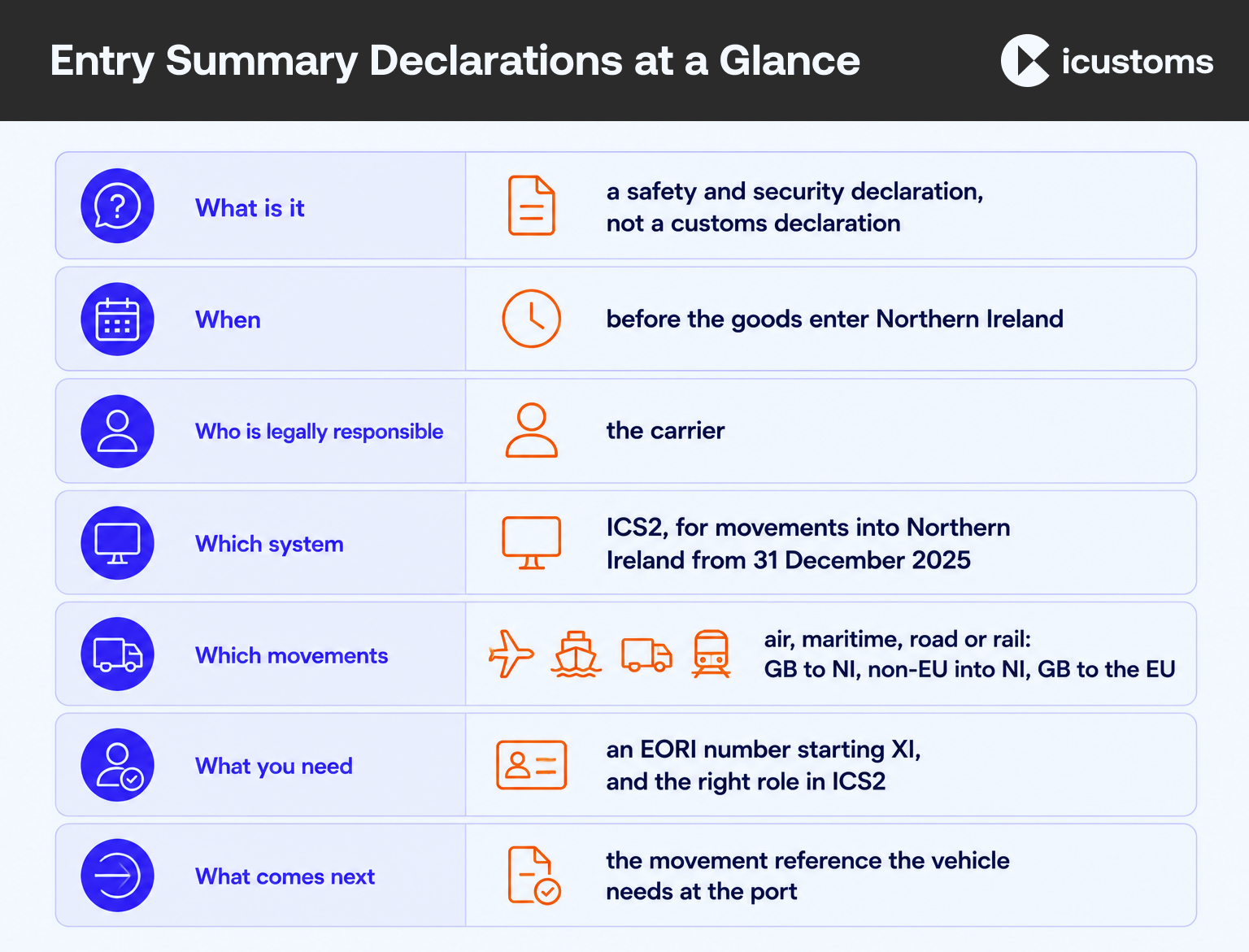
Entry summary declaration Northern Ireland rules at a glance
| Question | Answer |
|---|---|
| What is it | A safety and security declaration, not a customs declaration |
| When | Before the goods enter Northern Ireland |
| Who is legally responsible | The carrier |
| Which system | ICS2, for movements into Northern Ireland from 31 December 2025 |
| Which movements | Air, maritime, road or rail: GB to NI, non-EU into NI, and GB to the EU |
| What you need | An EORI number, starting XI for Northern Ireland, and the right role in ICS2 |
| What comes next | The movement reference the vehicle needs at the port |
What an entry summary declaration actually is
It answers a different question from a customs declaration.
A customs declaration is about duty and compliance: what the goods are, what they are worth, what is owed. An entry summary declaration is about risk: who is sending what, to whom, by which route, so authorities can assess a consignment before it arrives rather than after.
That difference explains everything else about it. It comes first, because assessment before arrival is the whole point. It sits with the carrier, because the carrier knows the movement. And it goes to a different system.
Two obligations, not one A single GB to NI movement usually needs both a safety and security declaration and a customs declaration. They are separate, they go to different systems, and they often sit with different parties. A trader who assumes the haulier covers everything, and a haulier who assumes the trader does, is the commonest cause of a lorry that cannot board. |
ENS responsibility: who has to submit it?
The carrier holds the legal responsibility for submitting the entry summary declaration.
That is worth reading twice, because a great many traders assume it is theirs. It is not. In practice, though, legal responsibility and practical execution are not always the same thing, and this is where real operations get untidy:
- The carrier is legally responsible.
- The data mostly originates with the trader, who knows what the goods are.
- A freight forwarder or intermediary often does the actual submission.
- TSS can complete the declaration where the parties are set up for it.
So the practical question is not who is legally responsible, which is settled. It is who is doing it for this movement, and does that person have what they need in time. Agree it per lane, in writing, and you will avoid the most avoidable delay in Northern Ireland trade.

Different jobs, different guidance
TSS publishes step-by-step material by user type rather than one generic guide, which tells you something about how differently the task lands depending on where you sit. There is separate guidance for hauliers, for freight forwarders, and for traders, with further splits for standard goods, controlled goods, excise goods and SPS goods.
If you move sanitary and phytosanitary goods, or anything controlled, do not work from a generic walkthrough. The data and the documents differ.
Which movements need an entry summary declaration?
Entry summary declarations apply to goods moving by air, maritime, road or rail on these routes:
- Great Britain to Northern Ireland
- Countries outside the EU into Northern Ireland
- Great Britain to the EU
You will need an EORI number, and for Northern Ireland that means one starting XI, plus the appropriate role set up in the ICS2 process.
Do parcels need an ENS?
Only some of them. Under the Windsor Framework, entry summary declarations are needed for some parcel movements from Great Britain into Northern Ireland, not all.
This catches out businesses that send both freight and parcels, because the answer differs by channel and by who is sending to whom. Check the parcel guidance for your specific case rather than applying your freight rule to a parcel.
What about NI to GB movements?
The routes listed above are the ones this obligation attaches to. Movements from Northern Ireland to Great Britain sit under different arrangements, which is a common point of confusion for businesses running both directions on the same lane.
ICS2 and what changed
The Import Control System for Northern Ireland has been replaced by the Import Control System 2 service, used for movements into Northern Ireland from 31 December 2025.
For anyone tracking the ICS2 Northern Ireland position specifically: the obligation did not appear with ICS2 and it did not go away with ICS. The safety and security requirement predates both. What moved was the system that receives the data.
If you are reading guidance, forum threads or blog posts written before that, treat anything they say about the mechanics with caution. This is one of the areas where out-of-date content is still ranking well and still being followed.
What has not changed is the substance: safety and security data is still required before goods arrive, and the carrier still holds the legal responsibility. What changed is the system that receives it, and with it some of the process detail.
If you want the wider picture of how this sits alongside the customs and movement systems, we have mapped the Northern Ireland customs system map, and our ICS2 declarations page covers the system itself in more depth.
What information goes in an entry summary declaration?
The safety and security data set is about the movement and the parties rather than the duty position. In broad terms it covers:
- Consignor and consignee
- A description of the goods, to the same plain-language standard as any other declaration
- Transport detail: mode, vehicle, carrier
- Routing information
- Other security-relevant data about the consignment
Requirements vary by movement type and by the kind of goods, which is why TSS splits its guidance the way it does. Standard goods, controlled goods, excise goods and SPS goods do not all ask for the same things.
The description field deserves particular care here, because the same standard applies and prohibited terms will cause a rejection at submission. We cover how to write one properly in what data a TSS declaration needs.
What happens after the ENS is submitted?
It is not the end of the process. It is the start.
ENTRY SUMMARY DECLARATION
Before the goods enter NI
↓
MOVEMENT REFERENCE
So the vehicle can board
↓
CUSTOMS ROUTE
Simplified, internal market or full
Creating the reference the vehicle needs at the port is the step that follows the entry summary declaration. That sequencing is the practical reason the safety and security data cannot be left until the last moment: something else depends on it.
Under the simplified route, the data you provide here also feeds what comes later. The supplementary declaration is auto-generated from it, which means an error at this stage propagates rather than staying put.
The mechanics of the port reference are covered in creating movement references in TSS, and the customs routes that follow in which declarations a movement needs.

How early is early enough?
The rule is that the ENS declaration must be submitted before the goods enter Northern Ireland. Exact lead times depend on the mode of transport and the route, so check the position for the lane you are running rather than applying one number everywhere.
In practice a different constraint usually bites first. The movement reference the vehicle needs at the port is built after this step, and the vehicle cannot check in without it. So the real deadline is not the legal one. It is whatever time the reference has to exist for the sailing you have booked, working backwards.
Businesses that treat safety and security data as part of the customs paperwork tend to run late, because customs work naturally gravitates to the end of the process. Businesses that attach it to the transport booking instead tend not to.
Exemptions and alternative routes
Not every movement of goods follows the standard path. TSS publishes separate guidance on oral declarations and on merchandise in baggage, both of which cover situations where the usual process does not apply in the usual way.
If your movement looks unusual, for example goods carried personally, or low-value items that do not fit the normal freight pattern, check whether one of these applies before assuming the full process is required. Equally, do not assume an exemption without checking. The categories are narrower than people hope.
Where ENS problems come from
| Problem | Why it happens | Fix |
|---|---|---|
| Nobody submitted it | Trader and carrier each assumed the other had | Agree ownership per lane, in writing |
| Submitted too late | Treated as part of the customs work rather than ahead of it | Build it into the booking, not the paperwork |
| Rejected on the description | Generic wording, or a prohibited term | Use the approved description for the product |
| Wrong EORI | GB number used where XI is needed | Check which identifier the route requires |
| Data does not match later | Corrected on the customs side but not here | Fix at source, not per declaration |
| Parcel treated as freight | One rule applied across both channels | Check the parcel guidance separately |
For businesses filing at volume, the safety and security data set is one of the most repetitive parts of the whole process, which is why it is a common starting point for automation. Our Entry Summary Declaration page covers that side of it.
Frequently Asked Questions
Do I need an entry summary declaration for GB to NI?
Yes, for goods moving by air, maritime, road or rail from Great Britain to Northern Ireland. Only some parcel movements need one.
Who is responsible for submitting the ENS?
The carrier holds the legal responsibility. In practice a forwarder or intermediary often submits it, and the data usually originates with the trader, so agree who is doing it for each lane.
When did ICS2 replace ICS for Northern Ireland?
The Import Control System for Northern Ireland has been replaced by ICS2, used for movements into Northern Ireland from 31 December 2025.
What information goes in an entry summary declaration?
Consignor and consignee, a specific goods description, transport and routing detail, and other security-relevant data. The exact requirements vary by movement type and goods type.
Do parcels need an ENS under the Windsor Framework?
Some do, not all. Check the parcel guidance rather than applying your freight rule.
Is an ENS needed for NI to GB movements?
The obligation attaches to movements into Northern Ireland and from Great Britain to the EU. Northern Ireland to Great Britain movements sit under different arrangements.
Do I need an XI EORI to submit an ENS?
For Northern Ireland movements you need an EORI starting XI, along with the appropriate role in the ICS2 process.
What happens after the ENS is submitted?
The next step is creating the movement reference the vehicle needs at the port. Under the simplified route, the data also feeds the supplementary declaration later.
Is an ENS a customs declaration?
No. It carries safety and security data. A customs declaration is a separate obligation covering the duty position.
Can TSS submit the ENS for me?
TSS can complete safety and security declarations where the parties are set up for it. Legal responsibility still rests with the carrier.
You may also like:
Preparing ENS Data Manually for Every Movement?

Simplify safety and security data preparation with iCustoms.
Subscribe to our Newsletter
About iCustoms
iCustoms is an all-in-one solution helping businesses automate customs processes more efficiently. With AI-powered and machine-learning capabilities, iCustoms is designed to streamline your all customs procedures in a few minutes, cut additional costs and save time.
Make Your TSS and ENS Workflow More Efficient
Reduce repetitive data entry across Northern Ireland movements.